Conegliano Valdobbiadene · UNESCO World Heritage

A land that tastes of wonder.

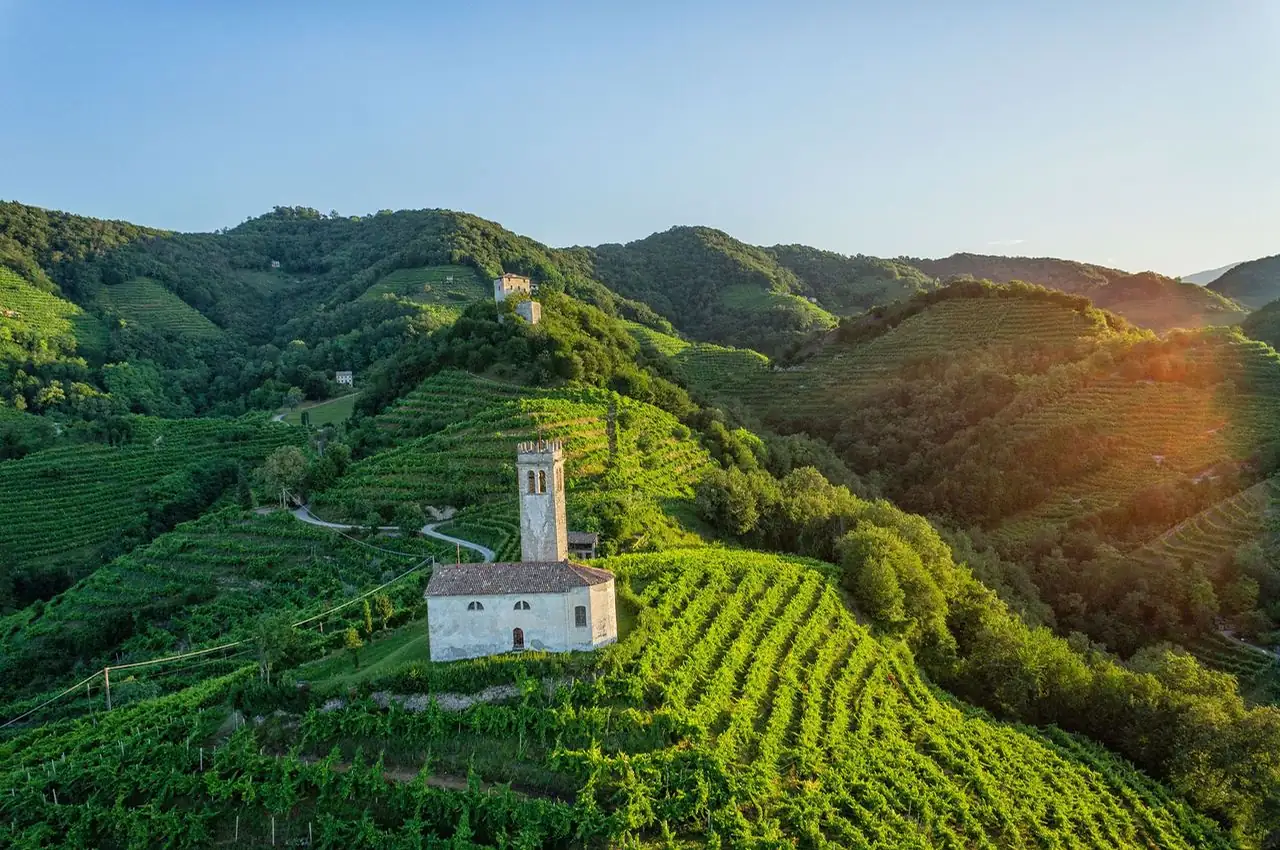
In the north-east of Italy, between the Dolomites and the Adriatic Sea, lies a landscape of rare beauty.

Green waves rolling over slopes that are at times steep and rugged.

The harmony between the skill of human hands and the majesty of nature.

In the second half of the nineteenth century, Antonio Carpenè understood the shape of this land and brought out its calling for winemaking, helping to turn a rural area into a winemaking excellence among the most admired in the world. For more than a century and five generations, the Carpenè family has looked after this heritage with the same passion and spirit of enterprise, keeping deep roots in its land, whose careful stewardship creates wonders for the palate.

A unique terroir

The soils hold the memory of the sea.

The Dolomites draw the horizon and shelter the vineyards from the cold north-easterly winds. A light breeze accompanies the seasons, keeping the climate mild and favoring the slow rhythm of ripening. The soils, once seabeds, still retain their character and minerality, preserving a legacy of sediments, clays and sandstones.

Sediments
Clays
Sandstones

The stratigraphic legacy of an ancient seabed.

World Heritage
2019

The Prosecco Hills of Conegliano and Valdobbiadene.

They stretch along a band of hills in the heart of the province of Treviso, from Valdobbiadene to Vittorio Veneto, reaching as far as Conegliano. In 2019 they were officially recognized as a heritage of outstanding value to humanity: an acknowledgment of a place where much of the work is still done by hand.

Hogback hills

The particular geological formation that gives the landscape its unmistakable profile.

Ciglioni

Grassy terraces without stone walls, shaped and maintained by hand, generation after generation.

A mosaic landscape

Vineyards living side by side with large stretches of woodland, tile after tile.

Heroic viticulture

600–700 hours of manual work per hectare. Every year.

Here the gradient rules out almost all mechanization: the work stays in the hands of those who do it, so much so that it is called “heroic”. In flatter areas, where mechanization is common, 150–200 hours are enough.

Conegliano Valdobbiadene hills
600–700
Flat areas
150–200

Up to four times the manual work required on the plains.

The appellations

Two perimeters, one origin.

D.O.C.G.
Controlled and Guaranteed Designation of Origin
Hectares
0
Bottles
0 M
Bottles / hectare
0

Only on the hills between the towns of Conegliano and Valdobbiadene. Elevation, a mild climate and the soils create the ideal conditions for Prosecco of superior quality: the most sought-after Martinotti-Charmat method sparkling wine in the world. The wines follow strict guidelines and are tasted and checked by the Consortium before they go on sale. It is the recognition reserved for wines of the highest quality, the pinnacle of territorial expression.

D.O.C.
Controlled Designation of Origin
Hectares
0
Bottles
0 M
Bottles / hectare
0

An area spanning Veneto and Friuli, 33% of which is Prosecco DOC Treviso. Every stage, from growing the grapes to making the wine, follows precise rules that guarantee quality, authenticity and a strong bond with the land. Choosing a DOC wine means discovering the authentic expression of Italian winemaking tradition.

The real scale
Area under vine
D.O.C.G. · Conegliano Valdobbiadene
8,088 hectares
D.O.C. · Veneto and Friuli
24,450 hectares
Bottles produced
D.O.C.G.
91 million
D.O.C.
439 million
Yield per hectare
D.O.C.G.
11,300 bottles / ha
D.O.C.
18,000 bottles / ha

The DOCG covers a third of the area and produces a fifth of the bottles: it is the tightest perimeter, the one of the hills.

From the land to the glass.

Five generations of care have made these hills a recognizable language. The bottle tells the rest.